-
পরবাস
বাংলা ভাষা, সাহিত্য ও সংস্কৃতি
Parabaas, a Bengali webzine since 1997 ... ISSN 1563-8685 -
ছোটদের পরবাস
Satyajit Ray
Rabindranath Tagore
Buddhadeva Bose
Jibanananda Das
Shakti Chattopadhyay
সাক্ষাৎকার -
English
Written in English
Book Reviews
Memoirs
Essays
Translated into English
Stories
Poems
Essays
Memoirs
Novels
Drama

The Land Where
I Found It All-

Order Here for Free Shipping in India
-

পুত্রবধূর কলমে গৌরী আইয়ুব এবং প্রসঙ্গত
-

বিশ্বের ইতিহাসে হুগলি নদী
-

বেদখল ও অন্যান্য গল্প
-

Audiobook
Looking For An Address
Nabaneeta Dev Sen
Available on Amazon, Spotify, Google Play, Apple Books and other platforms.
-

পরবাস গল্প সংকলন-
নির্বাচন ও সম্পাদনা:
সিদ্ধার্থ মুখোপাধ্যায়)
-

Parabaas : পরবাস : বাংলা ভাষা, সাহিত্য ও সংস্কৃতি -
পরবাস | English | Story
Share -
Serpentine : Manik Bandyopadhyay
translated from Bengali to English by Chhanda Chattopadhyay BewtraThe Lizard | Serpentine
By the time he reached the end of the vast field, it was four o’clock.
Before entering the village, Ananta stopped the palanquin, got off, and looked back. The path he had traversed stretched till far into the distance. Even from here he could see the lonely banyan tree they had passed long ago; it looked even sadder and more mysterious. Beyond that, the world ended at the horizon. It seemed as though the horizon followed him all the way from the tiny railway station where he gotten off at ten in the morning.
On his right and left were semicircular rows of trees, no more than three or four miles apart. Nearby, a large pond shimmered in the sun. On its shore stood a temporary makeshift hut of elephant reeds--a shelter for a farmer who kept watch day and night over a few bighas of Earth full of crops.
Ananta shaded his eyes with his palms and looked around. Who could imagine that Ketaki would write a letter and drag him into such a desolate place in the middle of nowhere!
But the palanquin did not stop even at this faraway village. Under the surprised gaze of the villagers, and ignoring the loud greetings of several canines, it passed through the village and continued along an unpaved jungle road until it finally stopped about half a mile away.
Ketaki herself had sent the palanquin and the bearers, so there could be no mistake. The building right in front must be her current residence.
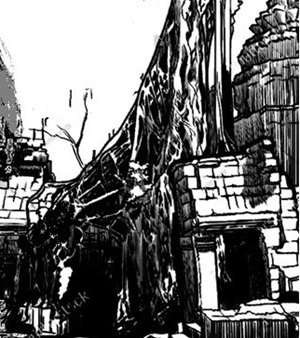
But it was difficult to imagine it as someone’s home. It seemed more like an archaeological relic.It was an old-fashioned mansion with three quarters: one side was in ruins except for about four rooms. Here stood a broken wall; there hung parts of a ceiling suspended by the skeletal remains of joists and rafters. The surrounding wall that once provided privacy to the house was completely destroyed. All around were piles of rubble and clumps of weeds. The portico was standing but only precariously. A huge peepal tree nearby cast its wide shade, deepening the unnatural silence all around.
A temple could be seen close by.
It didn’t look very old at first glance, but closer examination proved this abode of god to be about the same age as the ruined abode of humans next door. Yet, no damage could be noticed; not a single brick had fallen off. It was as if Time, wary of God’s wrath, had only touched the temple and didn't hit it hard.
The steps were broken, but again, not by Time. Who knew how many feet had trod on it for how long? It was amazing that it could still carry the devotees to their god.
Ananta was lost staring at the temple and didn’t realize when Ketaki came and stood by him. Her voice startled him.
“You have come after three years—” Ketaki smiled at Ananta’s surprised reaction and finished her sentence, “—and you are standing outside, looking at the temple!”
Ananta too smiled. “I was upset that you weren’t standing at the portico to welcome me.”
Ketaki replied, “I would have, but I didn’t expect you so early. Usually it takes until dusk to reach here.”
“The bearers just flew! You bribed them well with all that fancy food. Why did you send so much? If you sent all that so that I could take a tour around, then I shouldn’t have given it away—” Ananta laughed.
“You gave them away, fine. As long as you had enough for yourself.”
“I did. And was surprised that you remembered all my favorite items! Even the lime sherbet!”
Sun brightened one side of Ketaki’s face. She moved a little and smiled. “As if a lifetime has gone by that I should forget! You think one forgets everything in three years? Why, aren’t you surprised that I recognized you?”
Ketaki used to laugh exactly like this, speak in exactly the same tone; every sentence was perfect, like a little poem.
Yet she had changed--so much that he almost mentioned it at the start of their conversation. But that would have sounded trite. She might have taken it as merely another way of asking how one is doing, physically and mentally. After three years, would she want to describe all the changes in herself while answering such trivial questions?
He was even wary about asking how she was doing.
But ... her complexion had dulled, her stature had stooped, there was no youthful sweetness left in her face, and even her eyes seemed dimmed. How she had changed!
She did bathe at an unusual time, but still--
“You took a bath at this time? Are you going to worship in the temple?”
“Me, at that temple!” Ketaki sounded surprised.
“Why? Nobody goes there anymore?”
“They do. He does.”
Now it was Ananta’s turn to be surprised. Shankar worshipped in the temple! That atheist Shankar, who loved living in luxuries! Which god had suddenly entranced him?
“Which god is in this temple, Ketaki?”
“No god.” Ketaki shook her head. “It’s not a temple of god.”
Ananta was surprised. “Then whom does Shankar worship?”
Ketaki had turned pale. “Some evil star. Inauspicious fate. Forget about him.”
That was difficult to do. One couldn’t dismiss such an important fact about Ketaki’s husband. Ananta asked, “What do you mean by evil star and inauspicious fate? Can you explain?”
Ketaki’s eyes were moist. “What can I explain? The ancestral madness has consumed him. He has become a diehard devotee of goddess Kali since we came here. There is an idol of Kali in the temple, but he does not worship that; he worships his own insanity.”
Ananta thought for a minute, “Come, let’s go visit Mother Kali.”
“No!” Ketaki panicked.
“Why not?”
Ketaki’s face turned ashen. She swallowed and said, “You will be scared. You can’t recognize her as Ma Kali—she looks like solid darkness carrying a scimitar. Two eyes shine like diamonds. Even in daytime it’s dark inside the temple, and you’ve to light a lamp to see anything. The idol’s eyes immediately light up like the lamp too. When I saw it alone the first day, I fell unconscious.”
Ketaki shivered, and Ananta clearly understood her physical and mental conditions.
But he kept silent and watched her fight for self-control.
“Come, let’s go in,” Ketaki said.
“Yes, let’s. You never wrote any of this in your letters. I'm feeling unprepared at every step.”
“How can I write about all this in letters?”
“No... indeed.” Ananta too fell quiet. She wrote only the trivial news in her letters. Writing about this would have been really difficult for her. How could she convey the image of this house? Even telling about her own lean, pale looks would be impossible for her, let alone writing about it.
When they reached the portico, Ketaki smiled and said, “Why are you staring up at it like that? Nothing to worry while I am with you.”
“Does it mean a brick can’t fall crashing on our heads just because you are with me?”
“No, how can it? I’ve been walking in and out under this gate for three years; not even a speck of mortar ever fell on me. You know, the dangers of this house always avoid me.”
Ananta suddenly stopped. “Then let me ask you something, Ketaki. Why did you two have to make your nest in this ruined abode?”
“Where else can one find peace but in one’s ancestral ruins?”
Ananta was moved. “Who needed such a terrible peace? You, or Shankar?”
“He. Wife’s peace is in her husband’s.”
Only God could tell whether this was true or not! Ananta quietly followed her. A narrow path, perhaps made by Shankar and Ketaki’s daily walking, zigzagged around the piles of bricks.
Ananta kept thinking. Did he not guess the upheaval in Shankar’s life? Shankar had suddenly decided to relocate from the city to his ancestral zamindary. It was true that there had been some interesting changes in him even before this move, but Ananta had no reason to guess at any unrest in his mind. Shankar had become more serious, but also peaceful. He had turned away from all shallow, trivial pleasures of life, but with serenity. He seemed to have grown mature, gradually discovering the inner world that resided in all of us. This happened to many. Most people never worried about the eternal mystery of day-to-day living. Suddenly, some trivial event startles and makes him conscious of it. Perhaps something like this happened to Shankar too. He could only vaguely guess at the cause.But nobody could have imagined that all this was only the outer symptoms of Shankar’s inner emotional turmoil.
Yet, it was obvious now that Shankar was in considerable mental agony at that time. How could anyone live in a place like this? It wasn’t too long ago when he spent a ton of money and bought that picturesque house surrounded by gardens. He had spared no expense in providing all the luxuries. There he enjoyed all the urban amenities, the company of smart and polished men and women and spent his evenings in music and laughter. There he had the love of a happy, beautiful wife, not the wizened, timid one of today.
It can’t be that without any reason, Shankar had left that life and entombed himself in this place. Here he had not even shown any interest in clearing the weeds, removing the piles of broken bricks and rubble, or even cleaning up the few intact rooms. He just ran away from the modern luxury and buried his face in the ruins of his century-old glory.
Shankar had acted crazy on the day of their last meeting, but that was nothing compared to his present madness.
“Do you remember that night, Ketaki?”
“Which night?”
“When Shankar was ill, and both of us stayed up all night next to his bed?”
“Of course. That illness never got fully cured. He was restless for two months, then came here, leaving everything behind. … The next day, you were supposed to leave for Japan.”
“Yes,” Ananta seemed thoughtful. “After Shankar fell asleep, you came up to the gate to see me off. You gave some silly excuses and told me not to write; I still remember that well. … Did Shankar sleep through the rest of the night?”
“What a strange question after all these years!” Ketaki shook her head. “No, he didn’t. When I went back, he was sitting up in bed, rubbing ice on his forehead.”
Although they were walking slowly, they had almost reached the house.
Ananta lowered his voice. “I still can’t understand what happened to him that night.”
“There was an earthquake in his head.”
Ananta stood at the doorstep and acclimatized his eyes to the scene inside. There were signs of poverty and quiet acceptance of it. Everything was putting on a show —of poverty. The bed was made with a blanket. It looked like a thick shawl, perhaps was as soft too. A small rattan couch was placed in the middle of the room. A faded, torn rug covered most of the floor, perhaps purchased by Shankar himself for three or four hundred rupees. Along the north wall was a broken-door almirah laden with books.Shankar himself sat straight on a piece of carpet reading a book. He wore a hand-spun thick raw cotton shawl. He had cut his hair short, keeping a thick, long tress at the back. A swastika was drawn on his forehead with red sandalwood paste.
“Who? Ananta?” He exclaimed in great surprise and shut the book loudly. “I didn’t expect you would come! Kali, Kali! Goddess Almighty! What odd events occur in your world!”
What a strange greeting! Ananta was speechless.
“I wrote him a letter inviting him,” Ketaki explained.
“Good, but shouldn’t you have informed me about it beforehand?”
Ketaki looked at her husband’s serious face and smiled. “No, if I told you before, you would have told him not to come.”
Shankar gave a strange laugh. “Kali, Kali! Everyone misunderstands your child, Mother. I wouldn’t have stopped you, Ketaki, but I would’ve made proper arrangements to host him. He's your childhood friend. But can’t one have friends at an older age? Come, Ananta, come inside, take your shoes off.”
Ananta took his shoes off and sat on the couch. Ketaki didn’t reply to her husband; instead, she asked Ananta, “Would you like to take a bath?”
“No,” Ananta said.
“There is water in the verandah. Go wash up. I’ll bring tea. Or, would you like coffee?”
“Coffee!” Ananta replied.
Ketaki smiled and went indoors. Shankar yawned. “Kali, Kali! Not just coffee, Ananta, you would get cakes, pudding, sandwiches. And, and… if you insist, you will get everything. All junk food loved by the Hindus.”
Ananta smiled. “You’re talking nonsense, Shankar!”
“What did I say? Is she a Hindu girl? She can do anything. She will offer you tea and sing and play the organ for you too. Wait and see. There’s nothing she can’t do.”
Ananta was surprised. “Don’t you like her singing anymore, Shankar?” he asked softly.
“Like it?” Shankar replied sharply, “I feel insulted! Twenty-five years ago, if a wife in this family sang like that, do you know what would have happened to her? They would have choked her to stop her singing and sent her back to her parents for good. Wife of the Sonagaon’s Chowdhury dynasty, singing love songs!”
Ananta was really surprised, “She sings love songs? Here?”
Shankar had absently opened the book again. With hands trembling, he turned a few pages. “When she sings, angry faces appear on the walls. I know them all. My dad’s face appears right over there,” he pointed somewhere at the south-side wall, “—Ananta, the angry rebuke in their eyes, it will make you bow your head in shame. They move their pale lips and whisper at me, ‘Disgrace, disgrace to the family!’”
Ananta scanned all the walls. What was there to see? There were faint lines left by the dampness beneath the layer of whitewashing. Those definitely did not resemble any faces.
Yet he felt an urge to believe Shankar’s hallucinations. One never knew! He had already heard about the history of Shankar’s forefathers from Shankar himself. None of them could be said to be resting in peace. If they felt insulted by Ketaki’s songs and decided to appear on any wall, it would most likely be here, on these very walls.
Shankar was closely watching Ananta. Suddenly he changed his tone, “Please don’t tell her about all this. She’s a very nervous type.”
“I know that.”
“You know what she does at night? She comes to my window to take a look at me. Just seeing me alive eases her fear.”
Ananta was concerned. “She stays alone at night?”
“Of course. Her mahal is separate.”
“Mahal?”
“You don’t know mahal?” Sankar was surprised. “OK, let me explain: in our Chowdhury family, no man ever sleeps with his wife. That kind of dependency is not in our blood. The wife spends the night in her own quarters, keeping the lamp on the whole night. If the husband is in the mood, he would drop in on her; if not, he won’t.”
“So, loving one’s wife is not in the tradition of your family, is it?” Ananta asked seriously.
“Nope!” Shankar laughed. “We conquer women, don’t exchange hearts with them. You know, one of my ancestors was a king. If you couldn’t rule your own heart, what’s the point in being born in a royal family?”
None of them had noticed Ketaki standing by the door carrying soap and a towel for Ananta. Seeing her, Shankar became slightly subdued.
Ketaki softly replied, “May I know how much you earn every year by ruling over your own heart?”
Shankar too toned down his voice, “Did you hear everything I said?”
“No, not all, but enough. But let me tell you one thing, we women don’t fight over an empty, arid heart.” She smiled a little. It was clear to Ananta that she enjoyed replying harshly to Shankar.
It hurt Ananta, too, as if the distress were his own. It was never in Ketaki’s power to hurt even an enemy. Now she could hurt her own husband and smile at it!
Ananta stifled a sigh.
Ketaki spoke to Ananta, “I’m keeping the soap and towel next to the bucket. Go, wash up. Give me the key to your suitcase; I will take out your clothes.”
After she left with the keys, Shankar grasped his own ten fingers hard and said dejectedly, “Did you see, Ananta? How she showed her temper? I couldn’t even say a word in rebuke. See?”
Ananta stayed quiet.
“Me, a son of the Chowdhury family--I had to tolerate my wife’s harsh words. Oh Kali, Kali! Did you have to punish me with such shame? Was this to be my fate, Mother?”
The evening descended in a strange silence.Ketaki held on to the rod and stood silently by the east window for a long time. Perhaps there were other villages closer by, she thought, than the one they had to pass through on their way here. Faint growls of many dogs could be heard from a distance. The cool evening breeze had stopped sometime, without anyone noticing it. Haphazard, unreal thoughts jumbled in her mind.
It was difficult to grasp, within a couple of hours, all the changes that had occurred in the two friends over three years.
A while ago, Ananta had noticed the pestilence in Ketaki’s hair. Who knew what fire was burning inside her head? Suddenly, Ananta wanted to touch her head to gauge the inner heat that could cause such hair loss. When she was a girl, Ketaki had once knelt to touch his feet in obeisance. It was a long time ago. Why she did that he could not remember now. Perhaps there was no reason. All he remembered was that he had forgotten to offer his blessings. If she again touched his feet while saying goodbye—not for any reason, not because she had to—he would definitely place his hand on her head in benediction.
But what would he bless her with? Was there any possibility of anything good happening to her in this place? Would it not feel like a mockery if he just blessed her now, even silently?
Ketaki spoke up. “Look how it has gotten cloudy even before sunset. I think there will be a rainstorm tonight. How huge and dark the clouds are!”
“Why storm?” Ananta said, “It could be just rain only.”
“Sure,” Ketaki turned to smile. “But I’ve a feeling there will be a storm. Besides, see how humid it is. I’m sweating all over.”
She strained to hear something outside, then said, “Some folks are talking outside?”
“Let me see--”
Ananta stepped outside and saw Shankar standing on the verandah. Below him, on the ground, stood two peasants with folded hands. One of them led a plump goat tied to a rope.
Without being asked, Shankar answered, “Tonight there’ll be a sacrifice to Mother, Ananta. It’s customary to sacrifice a pair, but I had forgotten about it. Couldn’t get more than one goat in the last minute. Tonight I’ll have to worship the whole night.”
“Worship goddess Kali?”
Shankar smiled a peaceful smile, “You know Her as Kali; we call Her Shakti. Her restraint of that awesome power is what makes this world possible. She stores poison in one breast and elixir in the other to nurture all in the universe.”
“Except that goat!”
Shankar sounded like the all-knowing. “You don’t recognize destruction, Ananta; you don’t understand the nature of death. Does anything get lost from Mother’s store? Not even the insect that you unknowingly crushed under your feet. Today this goat will be sacrificed, but won’t Mother create him again tomorrow?” Shankar got down from the verandah and scratched the goat’s neck, seemingly with a lot of affection.
Ananta watched him for a while, and then asked, “But can you worship Kali on the eleventh day of the moon?”
“My dear Sahib, is there any bad time for worshipping Mother?” Shankar replied without turning.
“True, indeed.”
Ananta returned to Ketaki’s room.
“Has he gone insane, Ketaki?”Ketaki had not moved from the window. At Ananta’s frank question, she turned around, startled.
“That I don’t know. I think it was in his blood all the time. It has just come out. Before coming here, I had thrown a party. He took me inside, saying, 'I have to tell you something,' and bolted the door from outside. That was my first punishment. I never cried after that. That day I did and wondered how far Japan was.”
Ananta softly said, “Sit down, Ketaki, sit down and tell me.”
Ketaki sat down. “You weren’t around. Let me tell you the history of the last two months before we left. Every two or three days, he would have nightmares and wake up in terror. Trembling all over, he would call me, ‘Ketaki, wake up; turn on the lights, quick. I’m awash in blood!’ I would wake up hurriedly and turn the lights on to see him bathed in sweat. He would tremble in fear, trying to tell me about his nightmares, about a sky-high image of goddess Kali, huge tongue lolling on her chest, blood streaming from both corners of her mouth—in his dream he would be sacrificing humans at Her feet.”
Ketaki moved away to the window. Tears stood in her eyes. Looking outside, she said, “Since then we have been here. He wouldn’t even allow me to keep a maid. Some nights I am so terrified-- look, the way the clouds are gathering, it will be some storm tonight!”
“Nothing surprising in having a storm.”
“Do you know that a storm in Ashwin can be a lot more dangerous than a summer norwester?” The melodramatic tone of her voice clearly revealed her worries about the looming storm.
Ananta replied in an easy voice, “Sure, it can be. But don’t you light the lamps in your house in the evening? It’s getting pretty dark.”
“Who will do the lighting? Me? Better not embarrass the evening.” Ketaki smiled, “The servant will bring the lanterns.”
The servant must have been busy lighting the lanterns. Soon he brought one into the room.
Immediately, it changed the whole atmosphere in the room. As soon as the inside was lit up, the darkness outside condensed further and completely obliterated all the ruined buildings. It seemed to Ananta that he had just woken up from a bad nightmare in Ketaki’s room three years ago, not amongst piles of broken bricks and weeds but a beautiful flower garden at the end of which lay a crowded, brightly lit street.
Noises of utensils could be heard from the next room. After some time, both the servant and the cook came to the door. “We are leaving for the night, Madam.”
“Have you covered everything properly? OK, just wait a bit.” Ketaki turned to Ananta. “You better eat now and leave with them also. They will arrange your bed in the main office quarters.”
Ananta was surprised. “Why? You don’t have a room here?”
“Yes, but you better leave. Why would you want to sleep in this ruin?”
Ananta looked at Ketaki’s pale face and laughed, “Those poor guys are looking around, scared. If you don’t need them, let them go.”
“You won’t go?”
“Unless you want to, do you?”
Ketaki sighed. "OK, you both can go.”
As soon as they got the permission, they hurried out. Looking at them, Ananta couldn’t help laughing.
“You’re laughing,” Ketaki sounded sad. “God only knows how I am feeling. Everything is so still outside!”
Ananta stopped laughing.
He shouldn’t have laughed..
There was no music, no noise from the devotees. It was a silent worship by a lone priest. The humidity was increasing as the night progressed. In the realm of the stars, the clouds had created total moonless darkness. There was no sound anywhere, no heartbeat of life. Like the meditating, still priest before a still stone idol, the whole world, too, was stilled in silence, waiting for the release of some pent-up, terrible power.Occasionally some nocturnal bird called out. In the banyan tree, two venomous takshak-lizards screeched in turn. The wild pigeons rustled their wings in the small square spaces on the walls of the temple. Behind the temple, some animal splattered in the weedy, half-dried pond. A large beetle buzzed around the idol a few times, then hit the wall and fell on the ground. But these noises and the nonstop buzzing of the crickets only deepened the silence.
Ananta was overcome looking at Shankar. He sat next to the idol, keeping Her to the south. His eyes were half closed. There was a hint of a smile on his lips, an arid stoniness on his wide forehead. The sacrifice was already performed. The severed head of the goat was placed in front of the goddess with a bowl of blood as offerings. The eyes of the idol were shining like fire, but She had not drunk a drop of the blood. Only one drop was clotted on Shankar’s forehead.
Ananta was startled by a pull on his sleeve. She saw Ketaki was trembling. “Come away. I’m scared!”
Shankar heard her. “Scared? Pray to Mother for help.”
Ketaki pulled at Ananta again, “Come on.”
“Bow to Mother before you leave, Ketaki,” said Shankar. “Come, let me place my Mother’s vermilion on your head. Her blessing will remove all your fear. My Mother forgives everyone, everybody.”
It was crueler than killing someone even more helpless than the baby goat. Ketaki wrapped the free end of her sari around her neck and was going to kneel when Ananta held her back, “Just bow in your mind, Ketaki. Mother will be more pleased with that. Come.”
Picking up the lantern, Ananta held Ketaki’s hand and very carefully climbed down the broken steps. He didn’t realize that it was more dangerous to climb down the stairs together. But how dangerous could it be, after all; one doesn’t die in a fall of three or four steps!
Under the portico lay a large black snake, about three or four arm lengths long. In the light of the lantern, it raised its hood and stood still.
Both Ananta and Ketaki stopped in their track. Ketaki whispered, “Don’t move, don’t move the light or it will strike.”
Ananta murmured without moving himself or the light, “Is this the gentleman you were searching so fearfully? I was wondering why you were still so scared after leaving the temple. How long do we have to wait before he allows us passage?”
“One or two minutes.”
“So you are experienced. Is this another danger that avoids you at home?”
“Snakes are not dangerous!” Ketaki smiled.
The snake indeed proved to be non-dangerous. Another huge snake passed by barely two arms’ length from Ketaki and slowly slithered to its mate under the gate.
“His wife. Very docile.” Ketaki said.
“I can see that. Here even the king of death is very docile.” The wife slithered over the husband and vanished under a pile of bricks. The husband too lowered its hood and followed her.
But mating with his wife was not in his cards. Before he could disappear, Ananta picked up a large brick and flung it at its head with full force.
Ketaki whispered in terror, “What have you done?”
Ananta had no time to reply. The brick had broken the spine just below the hood. The snake was thrashing its body helplessly. Ananta kept hitting it with bricks one after another until its hood was completely smashed. The bloody body didn’t move anymore except the tail part, which still flopped from side to side.
Ananta dusted his hands. “Well, that leaves only the docile wife.”
Ketaki’s voice was hoarse. “Why did you kill him?”
“One must kill snakes, Ketaki,” Ananta said. “As one must repair a ruined house, to live in it.”
“But such a huge snake? With only bricks? What if you had missed? In one split second it could have--” Ketaki trembled in fear.
Ananta smiled, “It is dead now. No need to wonder what could have happened if I missed. But when you first exclaimed ‘what have you done!’, that was not for fear of my life, was it?”
Ketaki said, “He had ordered us not to. Once a servant killed a tiny snake, he whipped him till there was no skin left on his back. Even now the poor fellow has the scars. He thinks Ma Kali’s attendant dakinis and yoginis live here as snakes. Killing them is a great sin. It brings in bad luck, terrible consequences.”
Ananta quietly said, “I had guessed something like that, Ketaki. That’s exactly why I killed it.”
Ketaki turned pale. "That’s why you killed it? But you said one must kill snakes…”
“Yes, but I wouldn’t kill it with bricks. That's a dangerous practice. I would look for a sturdy stick. I won’t mind if the snake escapes in the meantime.”
“Then, why did you kill it like this? What did you realize?”
The tiny circle of light from the lantern was like a pathetic attempt at love against the violence of the surrounding darkness. Ananta remained quiet for a while, and then he spoke slowly, “I didn’t realize anything, Ketaki. How can we understand why Shankar’s love for this pile of ruins has turned him insane? He’s not expected to have any sympathy for snakes or a pile of rubble.”
Ketaki suddenly broke into a laugh. “No. That is true. He wants to live for a long time.”
“I know. I smelled carbolic acid in his room. That’s why he prays all night in the temple if there’s a storm.”
Ketaki changed the topic, “Come, let’s have dinner. Give me the lantern. I’ll go ahead.”
Ananta gave her the light but walked ahead of her. “If the docile snake-wife wants to take revenge for her husband’s death, she should attack me, Ketaki. I pray to God—”
“Why do you say such inauspicious stuff? Tomorrow you better go back home in one piece.”
The storm arrived in the early morning hours.Ketaki had said that early-autumn storms could be more severe than the summer norwesters. She was proven right within the first five minutes.
On the previous night, Ananta had to leave home very early. He had spent the whole day in a train and a palanquin and went to bed around midnight. It was difficult to wipe the sleep from his eyes, but also impossible to sleep through the thunderous noise outside. It was hard to figure out things in that half-awake, half-asleep state; only a feeling of vague terror lay heavy on his heart. It seemed as if some unknown disaster was looming towards him, but he was helpless to raise even a finger against it.
Something was going to happen, almost now! A delayed revenge from some unknown enemy would strike him suddenly from somewhere. The damp smell of wet Earth held a hint about the threat. Its angry knocks could be heard around the walls.
Suddenly something struck him hard and startled him into full awakeness. It felt like someone punched him hard in the chest and broke all his ribs. For a few moments he couldn't even breathe. He opened his mouth to draw in some air and felt his ribs hurt. He started moaning in pain.
But he couldn't stay like that for too long. He tried to feel for the matchbox in the bed, but found only dust and pebbles all over. One large tile, still stuck with cement and mortar, had fallen right next to him. He forgot the pain and sat upright. Now he realized the screaming along the walls outside was not just the wind; mixed with it was the loud moaning of every brick trying to break free.
Finding the matchbox, Ananta lit one stick with trembling hands. Noting the door’s location, he threw away the stick and jumped off the bed.
Outside the door, the ferocious wind and rain were in some crazy romp, churning the darkness all around. Ananta had never seen a storm like this before in his life. Standing up increased the pain in his chest, but he somehow crept forward, holding on to the wall. There was one room between his and Ketaki’s, but even that small distance seemed too far to cross. Ananta gritted his teeth.
At last, he felt the door to Ketaki’s room. In the glow of the lightning, he noticed that her door was bolted from the outside with a chain.
At first, he was relieved to think she must have left her precarious room and fled to the temple. If she were asleep, it would have been difficult to wake her over the din of the storm. There was no use knocking on the door; the wind had already been doing that for some time with mighty force. He didn’t even have the strength in his lungs to call her loudly enough to be heard over the howling storm. But he would have had to call her — it was impossible to stay in the house in this storm. It was good that she had left on her own for a safer haven.
But how could she leave without calling him? She, who was so anxious to send him away with the cook and the servant at the first possibility of the storm?
Ananta undid the chain. Both the doors flung wide in the wind.
There was a lamp lit in one corner. It had not gone off in the wind. Ananta saw Ketaki, completely wrapped in a sheet, perhaps sleeping without any worries. Across her chest lay a sturdy wooden beam.
It was clear that Ketaki had not kept the door open from inside and had fallen asleep. She must have tried to open the door bolted from the outside, but failing to do so, she went back to bed and fell asleep.
Ananta stepped closer and tried to move the beam from her.
The storm abated in the morning but didn’t stop completely.With bloodshot eyes, Shankar stared at the partly covered bodies under the piles of rubble. Then he found a broken basket and started carrying more bricks and rubble to pile on the two bodies.
He wanted to completely cover them. He had no objection to them sleeping forever in the same bed where they had loved each other the whole night. Just don’t let anyone else know about it.
How long does it take for a human body to turn to dust? At the end of the day, Shankar couldn’t pick up the last basket anymore and sat back to wonder.
Soaked in the rain, he shivered. The wind roared around him from time to time.
The original story 'Sarpil' (সর্পিল) was first published in the Bengali periodical Bharatbarsha (ভারতবর্ষ; মাঘ, ১৩৩৮) in 1931. It was later collected in Galpo Sangraha (Vol.1) (Gita Printers, Kolkata, 2011). The current translation has been made from the original story from Bharatbarsha.
অলংকরণ (Artwork) : Ananya Das - The Lizard | Serpentine
- মন্তব্য জমা দিন / Make a comment
- মন্তব্য পড়ুন / Read comments
- কীভাবে লেখা পাঠাবেন তা জানতে এখানে ক্লিক করুন | "পরবাস"-এ প্রকাশিত রচনার দায়িত্ব সংশ্লিষ্ট রচনাকারের/রচনাকারদের। "পরবাস"-এ বেরোনো কোনো লেখার মধ্যে দিয়ে যে মত প্রকাশ করা হয়েছে তা লেখকের/লেখকদের নিজস্ব। তজ্জনিত কোন ক্ষয়ক্ষতির জন্য "পরবাস"-এর প্রকাশক ও সম্পাদকরা দায়ী নন। | Email: parabaas@parabaas.com | Sign up for Parabaas updates | © 1997-2026 Parabaas Inc. All rights reserved. | About Us